

2026 Events: Scarecrows!
2026 Scarecrows in the Kilgore-Lewis House Gardens
October 15-November 6, 2026
“Red, White and Boo and Historical Too”
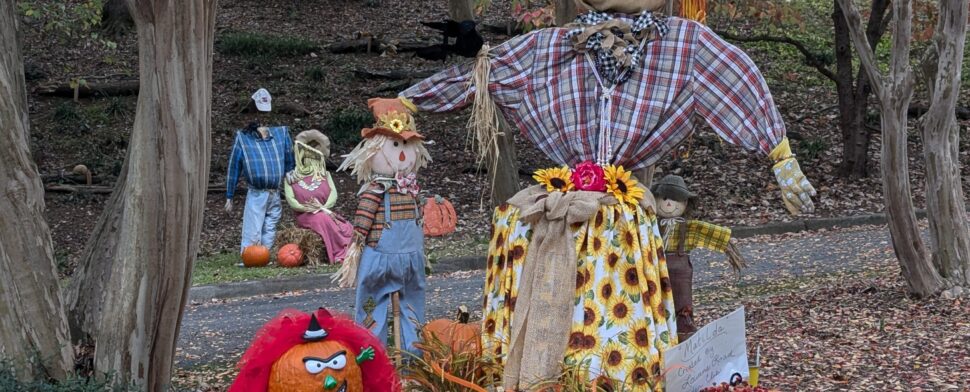
Find our 6 creative scarecrows in front of vintage wooden fencing. Each is created by Garden Clubs members as a fun interpretation of the historical figures!
Betsy Ross (1752-1836)
Betsy Ross was an American seamstress, upholster and businesswoman, best known for her association with the first American flag.
According to tradition, in 1776 she was asked by members of the Continental Congress in Philadelphia to sew a flag with 13 stars and stripes. While there is no definitive proof that she sewed the first flag, the story has become a lasting part of American history and symbolizes her patriotism and skill.
Betsy Ross lived a long life, raising a family and continuing her work as seamstress and businesswoman. She died in 1836 and is remembered as a patriotic figure and a woman who played a meaningful role in the early days of our nation.
Laodicea “Dicey” Langston: A Legacy of Courage
Laodicea “Dicey” Langston was born on May 14, 1766 in South Carolina’s Ninety-Six District, in what is now Laurens County, near Clinton, SC. Dicey was a teenager (14-15 yrs old) when she risked her life to defend her family and warn Patriot forces during the Revolutionary War. Her bravery helped save lives and disrupt Loyalist attacks at a critical moment in the fight for independence. Nearly 250 years later, her remarkable story continues to remind us that courage has no age limit.
Families and friends did many things to help the Patriots during the war. They made uniforms for the Patriot soldiers by spinning thread, weaving cloth and then sewing the uniforms. They also wrote letters and made baked goods, belts, shoes & boots for the soldiers. Also known as “Daring Dicey”, Dicey would pack up her horse, Liberty, and ride 4-10 miles at night (often without a lantern) to secretly deliver clothing, food and letters. Increasingly, Dicey overheard conversations of Loyalists in the village nearby. When Dicey overhead that the Loyalist Bloody Scouts were planning to attack families and soldiers near Eden settlement, Dicey rode during the night, including a scary crossing of the Enoree River, to inform her brother and other Patriots. The Patriot soldiers in turn were able to warn the Patriot families near them of the coming attack. When angry Bloody Scouts confronted Dicey’s father, Solomon Langston, accusing him of being a spy, Dicey stepped in front of him to prevent the Bloody Scouts from shooting her father. The Loyalists backed down and did not shoot them. Her father had not known that Dicey was riding in the middle of night to carry goods to her brother’s troops! Dicey was strong-willed and courageous!
Dicey met her future husband, Thomas Springfield, when Dicey’s brother sent Thomas to Dicey’s home to pick up a rifle. Thomas teased Dicey and would not tell her the password to get the rifle. Dicey stood her ground and refused to let him have it until he told her the password. After the war, Dicey and Thomas, both 16 years old, married and later moved to Travelers Rest, SC, where they lived the rest of their lives off Tigerville Road (a stone memorial and plaque is at the old homestead site).
In Travelers Rest, many are involved in creating a lasting place to honor Dicey’s courage and introduce visitors to the history, people, and natural heritage of the Upstate.
- Dicey Langston Heritage Garden at Spring Park: A life-sized statue of Dicey, created by artist Nick Ring, stands as a centerpiece of the garden.
- Charters of Freedom Plaza
- Future Revolutionary War-Themed Spy Hunt
- Future Rhodes Children’s Botanical Garden, where children and families will be encouraged to explore history and nature through native gardens, educational programming, children’s discovery areas, public art, and interactive experiences that celebrate both our Revolutionary history and the natural beauty of Travelers Rest.
- Spring Park Inn – open for tours (owned by the Travelers Rest Historical Society)
Sources/Links:
City of Travelers Rest website: https://travelersrestsc.com/visit/dicey-langston/
The Patriot Wore Petticoats. By author, Marnie Pehrson Kuhns
Spring Park Inn: https://travelersresthistoricalsociety.org/spring-park-inn/
Wood, Paul A. Jr. South Carolina Revolutionary Era Biographies; “Laodicea “Dicey” Langston Springfield”, September 29, 2022.
https://southcarolina250.com/wp-content/uploads/2024/08/Dicey-Langston-09-29-22-interactive.pdf
Dicey Langston Scarecrow (GCGC 2026 Fall Festival) by Mountain Laurel Garden Club
Jane Black Thomas (1720-1811)
Jane Black was born in Chester County, Pennsylvania and married John Thomas, who later became a colonel in the South Carolina militia. The couple eventually settled in what is now the upstate of South Carolina. During the Revolutionary War, Jane reportedly played an important role in warning Patriot forces of an impending British/Loyalist attack at Cedar Spring. According to historical accounts, she rode approximately 60 miles on horseback to warn the Patriot troops, allowing them to prepare an ambush rather than being surprised by the attacking force. She is described as a patriot heroine whose warning helped turn the engagement into a Patriot victory. She also famously defended the Thomas home and a supply of weapons from Loyalist forces while her husband was away. Historical accounts describe Jane and a small number of people at the home firing from the house and successfully convincing the attackers that a much larger force was defending it.
George Washington ( 1732-1799)
George Washington was a Founding Father and first President of the United States. Before this distinction and prior to his Military service, he was a surveyor as well as a planter. He pursued a career in the military amid the French & Indian Wars. He had mixed success. He tried politics and was elected to the Virginia’s House of Burgesses in 1758. After more restrictive legislation by the British, the Continental Congress was called. Washington was selected as a delegate to the First Continental Congress.
After the Battle of Lexington and Concord in 1775, the political dispute between Great Britain and American Colonies escalated into an armed conflict, the second Continental Congress was called, and Washington was appointed Major General and Commander-in-chief of the Continental Army. The Revolutionary war ensued…and in 1781 British General Charles Cornwallis surrendered to Washington ending the War for Independence.
After living under the Articles of Confederation, in 1787, Washington was unanimously chosen a president the Constitutional Convention to amend the Articles. The result was a new form of Government under a Constitution. After it was ratified, Washington was elected as the first President of the United States, unanimously. The only President in our history to have been so elected! The 57-year-old Washington took the Oath of office at Federal Hall in New York City, the capital of the United States at the time.
He served two terms mindful of the precedent of being the first president he chose to establish a peaceful transition of government. He returned to Mount Vernon his home in March of 1797.
Richard Pearis (Born about 1725 in Ireland- Died about 1794 in the Bahamas)
Richard Pearis, the first white settler in the Upstate, was an Irish adventurer who had settled in Virginia with his wife and family by the middle of the 18th century. He developed good trade relationships with the Cherokee, and had great interest in the land around the Reedy River as potential for manufacturing. Because white settlement was prohibited at that time, he had a son with a Native American woman, “Pleachy” or “Pratchy” and had a son named George. Through the son, being part Cherokee, he was able to acquire the title to 100,000 acres of Cherokee land in what is now Greenville County. Richard then set up his “Great Plains” Plantation with a trading post and grist mill on the banks of the Reedy River. Pearis was wooed by both Patriots and Tories when the American Revolution began. When he went with the British, Patriots burned his house, mill and store. He fled to the Bahamas and never returned to Greenville.
Paris Mountain is named for him, although they did not keep the same spelling.
Pleachy or Pratchy, a Cherokee Woman of High Stature
Pleachy was Cherokee and believed to have been the daughter of a Cherokee Chief. She had a son, George with Richard Pearis, who had traded with the Cherokee. Richard coveted the Falls on the Reedy River for setting up industry in this area….The only problem was this area was not open for White Settlement. (The approximate line between White Settlement/ Indian Territory was the now Greenville County/Spartanburg County Line.)
Pleachy’s son George, “bought” 100,000 acres because he was Cherokee! Shortly after that, Richard, having been made an “honorary” member of the tribe, bought the land from the son.
Waddy Thompson Sr. (1769–1845) — Greenville, SC
Chancellor Waddy Thompson Sr. was a Virginia-born American who later settled in Greenville, South Carolina about 1778. He served in the Revolutionary War when in Virginia, but moving into the upstate South Carolina, he practiced law. Waddy became a Judge over the Chancellery Court and was called Chancellor Thompson after that.
He bought a large tract of land in what is now Greenville that included the present Springwood Cemetery and the property where you now stand. This cemetery was originally the garden of Chancellor Waddy Thompson! He built the native stone well face over the natural artesian well that had been used by the Cherokee. This well became the first water source for the village. The keystone over the well says, “THANK GOD FOR WATER”. Due to its age and the elements, it is now difficult to discern.
Chancellor Thompson’s mother-in-law lived with the couple. When she passed away, she asked to be buried in her favorite spot. Her burial was the first in what is now Springwood Cemetery…. Waddy and his wife are buried beside her too. The “Spring” in the name is for the spring on the property and the “woods” surrounding the site!